



















Risk and reward: Finding the right balance in investing
When we hear the word “risk,” most of us immediately think of something negative — something to avoid. That instinct makes sense in many areas of life, but investing is a little different. In fact, trying to avoid risk altogether can sometimes create other challenges when it comes to reaching long-term financial goals.
Successful investing isn’t about eliminating risk entirely. It’s about understanding the different types of risk investors face, recognizing how they can affect your financial future, and finding ways to manage them over time. It also means understanding your own comfort level with uncertainty and how much risk you’re willing — and able — to take on. A willingness to take on more risk may result in higher potential rewards over the long term.
Risk is also often confused with volatility. While the two are related, they’re not the same thing. Risk refers to the possibility of losing money or not achieving the outcome you hoped for, while volatility describes how much investment values move up and down over time.
This article explores some of the key risks long-term investors face — including inflation, market fluctuations and longevity risk — and outlines strategies that can help you manage them with greater confidence.
Types of investment risk
1. Inflation risk
Have you ever heard someone say, “When I was your age that only cost a dollar”? They are referring to inflation — the general increase of average prices in an economy, accompanied by a decrease in the purchasing power of money.
When saving for a long-term goal, we typically plan for the future while being very much rooted in the present. But the cost of goods and services — everything from groceries to your morning coffee — will look quite different by the time you retire compared to when you started saving. Factoring in inflation is an important consideration when completing a financial plan.
👉 How inflation can deflate your cash
Investors who earn less than the rate of inflation are challenged by reduced purchasing power over the long term.
You may have greater exposure to inflation risk if all your savings are primarily sitting in cash. With today’s low interest rates, a cash-heavy portfolio can generate a negative real return after taking inflation into account. While this approach makes sense for short-term savings, an overly conservative investment approach can hinder growth potential and increase the risk of falling short of your long-term goals.
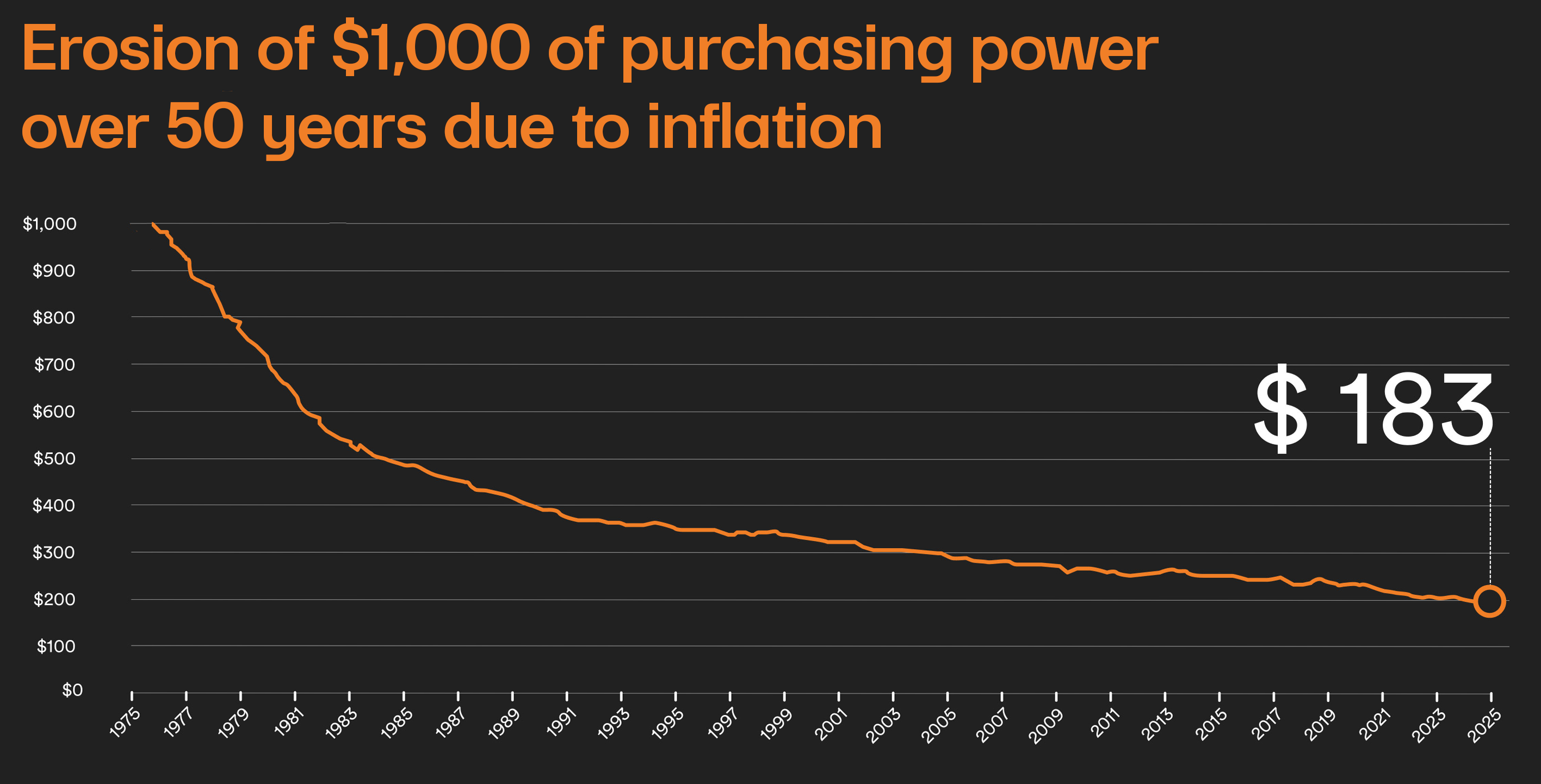
Source: Statistics Canada. Graph shows Core Canadian Consumer Price Index, not seasonally adjusted, from December 31, 1975 to December 31, 2025
2. Market risk
Market risk is associated with fluctuations in the market as a whole, rather than a single stock or business sector. Typically, when we think about market risk, we can become very focused on the day-to-day movements in the markets and the corresponding change in the value of our investments, with a heavy emphasis on recent activity.
However, when you look at the markets through a wider lens, the picture offers greater optimism. Historically, markets have recovered following downturns. While it can be tempting to flee to the relative safety of cash during periods of volatility, remaining disciplined and staying focused on your long-term goals may produce a better result than attempting to time the markets.
3. Longevity risk
Outliving one’s savings is a real risk for many, especially as life expectancies rise. Canadians are spending more years in retirement than previous generations, which increases exposure to inflation risk, health risks, and the risk of running out of money.
For many, outliving their retirement savings is a very real risk, but one that can be managed with proper planning and the right balance of investments for each stage of life.
Year |
Male |
Female |
1961 |
13.5 years |
16.1 years |
2024 |
19.8 years |
22.5 years |
Source: OECD, Life expectancy at 65 (indicator)
How to manage investment risk effectively
It’s important to remember that risk is an inherent part of investing. You cannot eliminate risk associated with investing, but you can certainly manage it. Here are some strategies to help you manage risk:
1. Diversify your investments
Diversifying a portfolio by combining different asset classes such as stocks, bonds, and cash equivalents — a process known as asset allocation — can help reduce overall portfolio risk and lower the impact of day-to-day market volatility1. This occurs because when some assets perform poorly, their losses may be offset by others that are performing well.
No single asset class consistently outperforms every year, and the best and worst performers can change from one year to the next. You can diversify even further by spreading out risk within an asset class, for instance, by owning stocks in different sectors or geographic regions.
A balanced portfolio with exposure to a variety of asset classes, sectors and regions provides the opportunity to participate in potential gains while aiming to lessen the impact of weaker-performing investments over time. Each Tangerine portfolio follows a diversified target asset mix associated with a particular investor profile.
READ MORE: Why diversification is an essential investment strategy
2. Get time on your side
It’s never too late to start investing — but there can be a significant advantage to getting in early.
Although contributing to long-term investments such as retirement savings is a leading financial priority for many Canadians, there always seems to be a reason to delay saving. The reality is that time is one of the most important advantages when it comes to investing, and it’s never too early to start saving for retirement.
You can start by setting up automated contributions of even a small amount each month. As your income grows later in your career, you can increase the amount. The earlier you start saving, the better positioned you may be, because your money has more time to benefit from compound growth. (Try our pre-authorized contribution calculator to get an idea.)
👉A timely lesson
Let’s look at the impact of delaying saving for retirement. Susan and Mark would both like to retire at age 65. Susan starts saving $100 biweekly when she’s 30. Mark decides to put off saving until he’s 45 but will contribute twice as much — $200 biweekly — to help catch up.
At age 65, Susan will have contributed $91,000 in 35 years, while Mark will have contributed $104,000 in 20 years. However, Susan will retire with $64,318 more than Mark — even though she contributed $13,000 less. With more time on her side to grow her savings (15 years more) and the benefit of compound growth, Susan’s $91,000 contribution grew to $240,167, while Mark’s $104,000 contribution grew to $175,849.
Numbers |
Mark |
Susan |
|---|---|---|
Biweekly contribution |
$200 |
$100 |
Over how long? |
20 years |
35 years |
Total contribution |
$104,000 |
$91,000 |
Investment growth |
$71,849 |
$149,167 |
Total savings at 65 |
$175,849 |
$240,167 |
*For illustrative purposes only and not intended to reflect an actual rate of return of the future value of an actual mutual fund or any other investment. The calculation assumes reinvestment of all income and no transaction costs or taxes. Illustration assumes a hypothetical rate of return of 5%, compounded annually. Amounts are rounded to the nearest dollar.
Note that while starting earlier can provide more time for potential compound growth, investment returns are not guaranteed, investment values may fluctuate, and the amount accumulated will depend on contributions, investment performance, fees, taxes and other individual circumstances.
Why understanding your risk tolerance matters
The degree of risk you’re willing to accept when investing is a critical factor in developing an investment plan. Just as some people may find bungee jumping thrilling while others prefer to stay grounded, investors have different comfort levels with risk.
While an aggressive investment strategy can be difficult for many to tolerate, an overly conservative approach can hinder growth potential and increase the risk of falling short of long-term goals, especially after factoring in inflation.
How to balance risk and reward in your portfolio
Having the right investment approach and asset allocation for your needs can help strike a balance and manage risk instead of avoiding it altogether. You may choose a less risky approach when it comes to short- and medium-term goals such as buying a house or car, while taking on more risk for goals that may be decades away, like retirement, since you have a longer time horizon to handle the ups and downs of the market.
Your Tangerine advisor can help assess your risk tolerance and put the elements of time, purchasing power, market and longevity risk into perspective by building an investment plan tailored to your unique needs.

Get investment advice when you need it
Just say the word, and we'll have a Tangerine Advisor reach out at a time that works for you.
1Diversification does not guarantee a profit or protect against loss.
Deposits to TFSA and RSP Accounts are subject to the limits imposed by the Canada Revenue Agency (CRA). You are fully responsible for monitoring your individual contribution limits and ensuring any and all deposits fall within these set CRA limits.