


















What does Total Cost Reporting mean for my investments?
Think about the last bill you received. The most important number was probably the total amount due. Ideally, that bill would include all fees and charges and present them in an easy-to-read format. This is the idea behind Total Cost Reporting (TCR).
Starting in early 2027, Canadian investors will see a clearer picture of the total costs of owning certain investments. The costs themselves aren't changing — only how they're reported.
Here's an overview of what you need to know.
What is Total Cost Reporting (TCR)?
Total Cost Reporting (TCR) is a Canadian regulatory initiative designed to give investors a more complete picture of the costs of owning an investment fund, such as a mutual fund or exchange-traded fund (ETF).
Today, some investment costs are easy to see, while others are built into the fund and reflected in their performance. TCR brings those costs together in one place, making it easier for you to understand the full cost of investing.
TCR introduces a new reporting term called the Fund Expense Ratio (FER), which combines a fund's Management Expense Ratio (MER) and Trading Expense Ratio (TER). (More on those terms below.)
The goal of TCR is to provide greater transparency so Canadians can better understand both the costs and value associated with investing and make more informed decisions.
Why is Total Cost Reporting being introduced?
TCR is the latest step in Canada's Client Relationship Model (CRM), a series of investor-focused reforms that began in 2013.
Each phase has given investors more information about their investments, from suitability to fees to performance. Now the newest phase aims to help investors better see the total cost of owning investment funds.

How investment fee reporting has evolved in Canada: a timeline
2013: CRM 1
Established fundamental requirements for fair dealing with clients.
✅ Introduced the Relationship Disclosure Document
✅ Enhanced suitability standards
✅ Enhanced disclosure of conflicts of interest
2017: CRM 2
Improved the transparency of fees and performance.
✅ Introduced annual Report on Charges and Other Compensation
✅ Introduced Annual Investment Performance Report
2027: CRM 3
Comprehensive view of costs associated with investment funds.
✅ Introduces Total Cost Reporting (TCR), requiring firms to disclose the full cost of owning an investment fund
Does Total Cost Reporting introduce new investment fees?
No, these aren’t new fees. In fact, this is one of the biggest misconceptions about TCR. The costs you'll see have always existed. They're simply being reported more clearly.
Total cost reporting changes disclosure, not fees
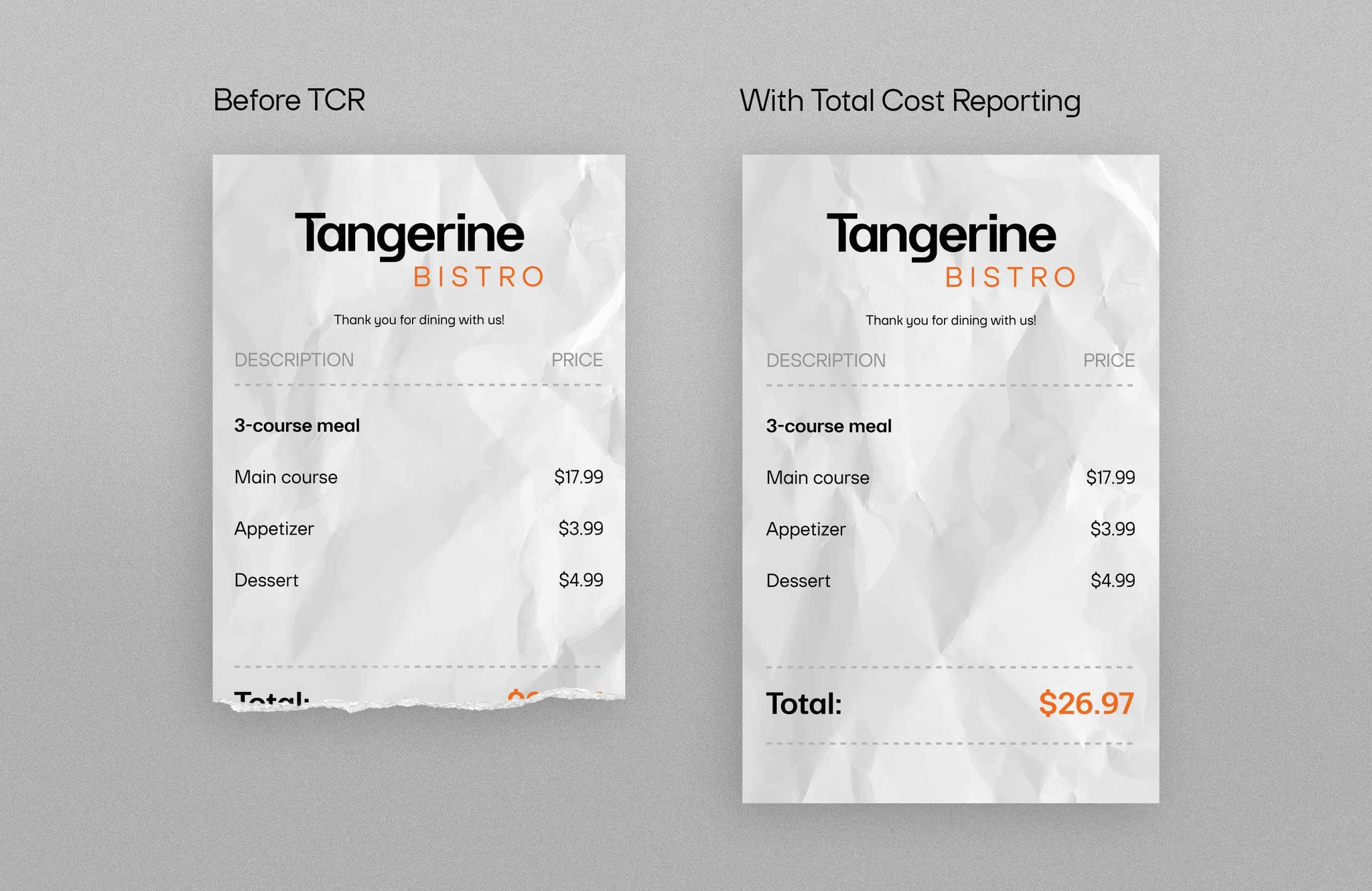
Consider the example of going out for dinner at a restaurant.
Imagine ordering a three-course meal. Would you prefer a bill that only shows the total cost of the appetizer, main course and dessert, or one that also includes taxes and any applicable service charges or gratuity? Most people would choose the bill that gives you a better understanding of what you actually spent.
That's the idea behind Total Cost Reporting. It doesn't change what you pay — it simply shows more of the complete picture.
With TCR, you see the full costs, not just a portion
What costs will I see under Total Cost Reporting?
TCR builds on the information you already receive. You'll continue to see charges and compensation that are already disclosed, such as trailing commissions associated with advice and service. Tangerine’s series A funds charge a trailing commission since clients receive advice from advisors.
What's new is that you'll also see the embedded costs that are built into your investment funds. These costs aren't billed separately since they're already reflected in the funds’ returns.
MER + TER = FER
Here's what the new terms mean.
What is a Management Expense Ratio (MER)?
Think: M = Management.
The ongoing cost of owning an ETF or mutual fund that covers professional investment management, operating expenses and taxes — and, in some fund series, advisor compensation. These underlying costs are embedded within the fund, meaning they are not charged separately to investors.
What is a Trading Expense Ratio (TER)?
Think: T = Trading.
Reflects the costs associated with buying and selling securities within the fund. These trading-related costs are embedded within the fund, rather than charged separately to investors.
What is a Fund Expense Ratio (FER)?
Think: F = Full.
The reporting term is new, but the underlying costs are not. It combines MER + TER into one figure, offering a full view of total embedded fund costs, hence the name “total cost reporting.”
What will Total Cost Reporting look like on your statement?
Beginning in January 2027, you'll see Total Cost Reporting on your annual fee disclosure report included with your Personal Portfolio statement from Tangerine.
The report will cover investment costs from the 2026 calendar year and will be delivered the same way you currently receive your statements — either electronically or by mail.
After that, you'll receive an updated report each year showing the previous year's investment costs.
How will fund costs appear on your statement?
When you receive your investing documents, you'll see these costs in two ways:
1. As a percentage for each fund you own (the Fund Expense Ratio or FER).
2. As a total dollar amount showing the fund expenses you have paid on your holdings during the reporting period.
For example, imagine you have $100,000 invested in Tangerine’s Balanced Income ETF Portfolio, with an MER of 0.75% and a TER of 0.03%. Here’s what your statement would show under Total Cost Reporting:
|
Percentage |
Dollar amount |
|
|
Management Expense Ratio (MER) |
0.75% |
$750 |
|
Trading Expense Ratio (TER) |
0.03% |
$30 |
|
Fund Expense Ratio (FER)1 |
0.78% |
$780 |
Note: This example is for illustrative purposes only and assumes a single fund held for the entire year. Actual fund expenses reported to investors will vary based on the amount invested, how long investments were held during the reporting period, market value changes and any applicable fee waivers or rebates.
The chart below shows Tangerine’s low-fee2 Series A mutual fund portfolios, along with their respective MER, TER and FER percentages.
| Portfolios | MER | TER | FER | FER paid annually on $1,000 |
| CORE PORTFOLIOS | ||||
| Tangerine Equity Growth Portfolio | 1.06% | 0.01% | 1.07% | $10.70 |
| Tangerine Balanced Growth Portfolio | 1.06% | 0.01% | 1.07% | $10.70 |
| Tangerine Dividend Portfolio | 1.06% | 0.03% | 1.09% | $10.90 |
| Tangerine Balanced Portfolio | 1.06% | 0.01% | 1.07% | $10.70 |
| Tangerine Balanced Income Portfolio | 1.06% | 0.01% | 1.07% | $10.70 |
| GLOBAL ETF PORTFOLIOS | ||||
| Tangerine Equity Growth ETF Portfolio | 0.75% | 0.01% | 0.76% | $7.60 |
| Tangerine Balanced Growth ETF Portfolio | 0.75% | 0.01% | 0.76% | $7.60 |
| Tangerine Balanced ETF Portfolio | 0.75% | 0.01% | 0.76% | $7.60 |
| Tangerine Balanced Income ETF Portfolio | 0.75% | 0.03% | 0.78% | $7.80 |
| SOCIALLY RESPONSIBLE GLOBAL PORTFOLIOS | ||||
| Tangerine Equity Growth SRI Portfolio | 0.80% | 0.04% | 0.84% | $8.40 |
| Tangerine Balanced Growth SRI Portfolio | 0.80% | 0.03% | 0.83% | $8.30 |
| Tangerine Balanced SRI Portfolio | 0.80% | 0.03% | 0.83% | $8.30 |
| Tangerine Balanced Income SRI Portfolio | 0.81% | 0.03% | 0.84% | $8.40 |
Does Total Cost Reporting apply to every investment?
Not quite. TCR applies only to investments with embedded costs (fees built into the investment itself), including mutual funds, ETFs and certain other investment funds with embedded costs. It doesn't apply to investments such as individual stocks, bonds and GICs.
The good news is that these rules apply across the Canadian investment industry, so you'll receive similar cost reporting regardless of where you hold investments with embedded costs.
What do investment fees pay for?
Going back to the restaurant example, when you pay for a meal, you're paying for more than just the value of the ingredients. Someone else plans the menu, sources the ingredients, prepares the meal and cleans up afterward. You sit down and enjoy.
Investment fund fees work in much the same way. Here are some of the services and benefits they help pay for.
Professional management and advice
Investment fund fees may help cover professional investment management services. The low-fee2 mutual funds at Tangerine follow a rules-based strategy under professional oversight covered by the fees. The embedded fees also provide clients access to professional one-on-one advice from a Tangerine advisor.
Convenience and time savings
Managing your own investments takes time. Investment funds allow you to leave the day-to-day research, trading, portfolio construction and ongoing monitoring to professionals, so you don't have to do it yourself.
Peace of mind
Knowing your investments are being professionally managed — and having an advisor to guide you — can provide confidence during changing market conditions.
In fact, four out of five3 Canadians say their advisor makes them feel more confident about their financial situation.
Why understanding Total Cost Reporting matters
Total Cost Reporting doesn't change what you pay. It changes how investment costs are presented, providing a clearer and more complete picture of the costs associated with investing. Understanding both the costs of investing and the services those costs support can help investors make more informed decisions and have greater confidence in their investment strategy.
1 The FER is generic and does not take into account client-specific fee waivers, rebates or absorptions. The fund expenses is the estimated total dollar amount paid indirectly in fund expenses for all the investment funds owned during the reporting period. This amount depends on each fund’s fund expenses and the amount invested in each fund, and the number of days the fund was held. This example is for illustrative purposes only and assumes a single fund held for the full year with no market value changes. It is not intended to represent actual fees for any Tangerine Investment Funds portfolio.
2 A fund's expenses are made up of the management fee (including the trailing commission), operating expenses, trading costs, and fixed administration fee. The annual management fee is 0.80% of each Tangerine Core Portfolio, 0.50% of each Tangerine Global ETF Portfolio, and 0.55% of each Tangerine Socially Responsible Global Portfolio. The fixed administration fee is the same for all Tangerine Investment Funds and is 0.15% of each Portfolio’s value.
3 Source: Scotia Global Asset Management Investor Sentiment Survey (Fall 2025).

Get up to a 3% bonus on your investments
Earn more for your investment journey. Start with 2% when you invest, then refer a friend to reach 3%.*