



















Five strategies for growth investors to consider
Thinking about the best way to invest your money for the future? Growth investing is all about aiming for bigger potential returns, even if that means dealing with greater ups and downs along the way. History shows that stock markets have provided returns that beat inflation and delivered the strongest results over time — but stocks don't move in a straight line, increasing in value as time goes on.
As a growth investor, you're prepared to ride out market swings because you believe in the long-term potential of your investments.
In this article, we'll break down what growth investing really means, who it's best for, and some simple strategies that can help you build wealth while managing the risks of a stock-focused portfolio.
What is growth investing?
Growth investing means aiming for higher long-term returns by holding mostly equities and other assets with strong growth potential. They accept more short-term volatility for the chance of greater long-term gains.
This contrasts with conservative investors who focus on preserving wealth and balanced investors who mix stocks and bonds for steadier results.
This approach is best suited for people with a long time horizon and a high tolerance for market swings, such as mid-career professionals with decades to invest, young savers building retirement wealth, or anyone who can watch their portfolio fall sharply without abandoning the plan.
The risks of growth investing
The rewards of growth investing come with some pretty big risks. Before deciding on a growth strategy, it's critical to understand the potential for significant losses. For example, during the global financial crisis of 2008-09, broad U.S. and Canadian equity markets lost more than 50 percent of their value from peak to trough. It took several years to recover fully. Many investors who sold in panic locked in those losses permanently.
More recently, the COVID-19 crash of March 2020 saw global equities drop more than 30 percent in a single month, followed by a rapid rebound. In April 2025, U.S. and international markets sank sharply after the Trump tariff announcement, only to recover within weeks. But a quick bounce back is not guaranteed. Not every downturn ends swiftly, and some can drag on for years.
Investors need to assess three things before committing to a growth portfolio:
- The ability to take on risk (your financial situation and how much volatility your time horizon allows);
- Your appetite to take on risk (how comfortable you feel with market ups and downs, and how you react when investments lose value);
- And the need to take on risk (whether you actually require higher returns to meet your goals).
You may need to choose a more balanced or conservative approach if you can't stay invested through a multi-year decline of 40 or 50 percent. A growth portfolio only works if you can hold it through the worst markets. Selling at a loss could turn your growth portfolio into a shrunken one.
👉 Did you know? All mutual fund dealers, including Tangerine Investments, are required by regulators to create an investor profile that includes your financial situation, investment objectives, time horizon, risk tolerance and knowledge of investing. By answering a series of questions, both you and the dealer can determine an investing plan best suited to your situation.
1. Embrace equity-heavy portfolios
Stock markets have historically delivered the highest returns of any major asset class. Over the past century, Canadian and U.S. equities have produced annualized returns of roughly 8 to 10 percent, compared with 4 to 5 percent for bonds and little more than inflation for cash. Investors earn that extra return because they’re taking on the higher risk of owning shares of real businesses whose valuations can rise and fall over time.
A typical growth allocation might be 90 percent equities and 10 percent fixed income or cash for liquidity.
👉 Did you know? Tangerine has three Equity Growth Portfolios, each invested 100% in stocks.
Spreading your investments across countries and industries (aka diversifying) reduces the impact if any one market or sector stumbles while still giving you access to the world’s engines of profit and progress. Canadian banks and energy firms make up only a sliver of the global market, so relying on them alone limits your growth potential. U.S. technology leaders can provide innovation and scale, European industrials provide global manufacturing strength, and Asian manufacturers give you exposure to fast-growing economies and sectors like clean energy or biotechnology for long-term structural growth.
Remember that a 90-percent-equity portfolio can lose 30 to 50 percent of its value in a severe bear market. If you aren't comfortable with that level of fluctuation, you might want to pick a different investment strategy.
2. Consider investing in emerging markets
Emerging markets include fast-growing economies such as India, Brazil, China, and several African nations. These economies often expand more quickly than countries with developed markets, which may translate into higher stock returns.
These opportunities can come with added risk: political instability, less-developed financial systems and currency volatility.
Recent years have been challenging for emerging market investors. Currency swings, geopolitical tension, and uneven growth have kept returns below those of the American or Canadian markets.
But history shows emerging markets can lead the pack from time to time. From 2003 to 2007, emerging markets delivered double-digit annual gains and outperformed Canadian, U.S. and international developed stocks by a wide margin.
A small allocation of five to 10 percent of your equity exposure can provide growth potential without overwhelming your portfolio. One strategy is to use diversified ETFs or mutual funds to spread risk across many countries.

Get up to a 3% bonus on your investments
Earn more for your investment journey. Start with 2% when you invest, then refer a friend to reach 3%.*
3. Explore alternative investments
Some growth investors add alternative investments, such as private equity funds or commodity ETFs, that do not necessarily rise and fall at the same time as or to the same degree as regular stocks and bonds. Examples include:
- Private equity funds that invest in private companies that aren't listed on the stock market
- Commodities ETFs that track resources such as gold, oil or agricultural products
Alternatives have gained popularity as investors look for new sources of return and diversification outside public markets.
These potential rewards come with trade-offs. Private investments often have higher fees, limited access and long holding periods. They may complement, but not replace, a globally diversified equity portfolio.
Approach these investments cautiously and consider keeping your allocations in this category small.
The effect of time on investing strategies
The graph below shows the range of possible outcomes for three risk profiles invested over different time periods between Jan. 1, 1986 and Oct. 30, 2025. The outcomes show that the longer you stay invested, the less volatility is apparent.
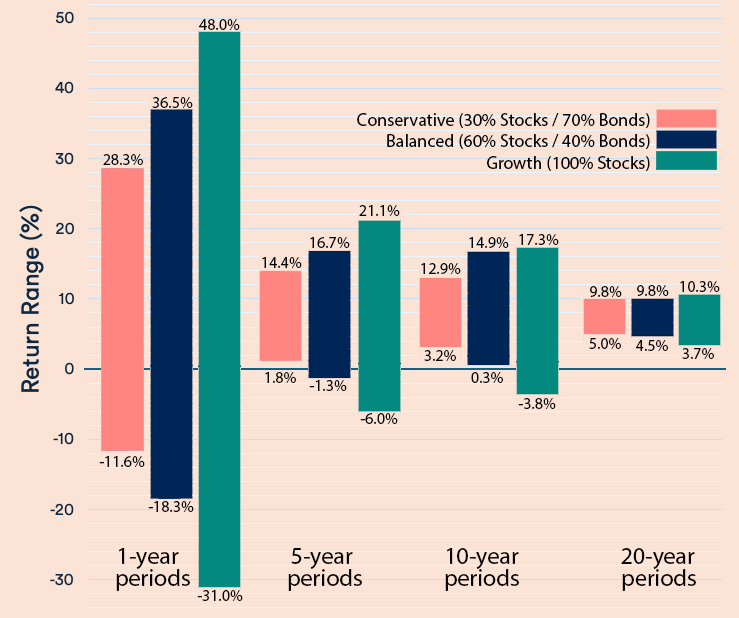
Data: Rolling 1-, 5-, 10- and 20-year periods on the FTSE Canada Universe Bond Index (for the bond part of the portfolios) and the MSCI World GR Index (for the stock component), from Jan. 1, 1986 to Oct. 30, 2025. Source: 1832 Asset Management L.P.
4. Higher-risk strategies to approach with caution
High-risk investments can swing wildly and wipe out money fast, so approach them carefully.
- Short selling involves betting that a stock’s price will fall, and losses could exceed your initial investment if the price rises instead. While the potential gains are high, there is theoretically no limit to how much you can lose by short selling.
- Cryptocurrency speculation means trading digital coins whose value can surge or crash within hours. The industry has its fair share of fraud, and crypto exchanges and wallets can be vulnerable to hacking.
- Day trading is buying and selling stocks on the same day to capture price moves, a strategy where most participants lose money over time.
- Algorithmic bot trading uses automated programs to place rapid trades, which can magnify investment mistakes and lead to large losses in volatile markets.
These strategies are not part of Tangerine's recommended Portfolios and should only be considered if you fully understand the risks.
5. Reinvest gains to maximize compounding
Charlie Munger, the longtime business partner of Warren Buffett and vice-chair of Berkshire Hathaway, famously said, “The first rule of compounding: Never interrupt it unnecessarily.”
Growth investing relies on putting your money to work again and again. When you reinvest your profits — like dividends or gains from selling investments — those extra dollars can start earning their own returns. Over time, that snowball effect may help your wealth grow faster.
For example, a $10,000 investment earning 8 percent annually grows to about $21,600 after ten years if you reinvest everything. Take the dividends as cash instead, and the total will be far lower. Automatic dividend reinvestment plans or simply directing distributions back into the market keep your money working.
Contribute regularly to enhance those compounding efforts.
Consider a 25-year-old who invests in a 90/10 growth portfolio, contributing $500 a month and earning a historical average of 8 percent annually. After 40 years, when that investor is 65, that steady plan could grow to about $1.75 million.
To maximize the power of compounding, make regular contributions, invest over long time horizons, and reinvest all gains.
Pop Quiz: Which may be considered the key to smart growth investing?

Taking calculated risks
That's right!
Going with your gut.
Not quite.
Try again.
Not being afraid to gamble it all away.
You knew this one was wrong. You just wanted to see what the other side of the card said, right?
Review, refine and stay the course
Check your portfolio at least once or twice a year. Rebalance if your allocation drifts more than 5 to 10 percent from your target. If equities rally and your 90/10 mix becomes 95/5, sell a little stock and add to your fixed income position to stay on target.
👉 Tangerine Portfolios are reviewed and rebalanced as needed every quarter.
The hardest part of investing is staying invested during downturns. The 2008 crash lasted years, testing even experienced investors. Those who stayed disciplined were eventually rewarded. Those who sold in fear often missed the recovery.
Set rules in advance so you act on discipline rather than emotion. Diversification across sectors and regions cushions the blow when one area struggles.
Final thoughts: Bold, not blind
Growth investing is about calculated risk, not gambling. By tilting heavily toward equities, adding a measured slice of emerging markets or alternatives, reinvesting gains, and rebalancing regularly, you give yourself the best chance of building wealth that outpaces inflation and supports long-term goals.
But remember that "long-term" means at least a decade and often much longer. Market history shows there will be sharp and potentially frightening declines along the way. Know your ability, capacity and need to take on risk before you commit, and be sure you can stay the course when the next downturn arrives.
It's the patience and discipline to stay the course through painful downturns that could lead to positive growth over the long term.
Learn more about how Tangerine Investments can help you reach your goals.