



















Common investment mistakes
There are lessons to be learned from other people’s mistakes. In his two decades as an investment advisor, Michael Allen, Tangerine’s head of advice, has seen them all. A few he’ll admit to learning the hard way.

Here he shares some of the most common errors that can prevent investors from earning as much as they otherwise would.
1. Overcomplicating things
It is easier than ever for Canadians to start investing in stocks, bonds and more, just by tapping an app on their phones. But with that ease comes complication, warns Allen.
“Investors have so many choices now, it can be overwhelming,” he says, pointing to a recent report that there are now more ETFs (exchange traded funds) than there are stocks in the U.S. market. “How are individual investors supposed to choose between them?”
To simplify things, he suggests investors consolidate their investments at a single institution so it’s easier to keep track. The investing itself can be simplified by focusing on a few investment funds that align with your goals (see below), and that track major global market indexes.
2. Letting emotions drive your decisions
“It doesn’t matter whether you’re brand new to investing, or you’re an old pro,” Allen says. “You have to be aware of your own emotional reaction to market swings.”
He recalls working in 2008, selling securities to institutional investors, “who are supposed to be the most sophisticated of them all.”
When the markets were hit by that year’s financial crisis, “they went into full-on panic mode.” They wanted to sell at a loss rather than wait it out.
“That same week, I was talking to my mom who’s a hairdresser in London, Ont., and I asked if she’s OK. She told me she hadn’t looked at her investments in months, and she’s not going to look now.
“She trusted that the market would just come back eventually. And she was right.”
The lesson? “Just because you understand investing, doesn’t mean you have the emotional control to handle the ups and downs. Distancing yourself from simply ‘pressing sell’ at the wrong time can save you a lot of future regret.
“Swings in the stock market – what we call volatility – is not in itself the risk,” he adds. “It’s overreacting to that volatility that is the true risk.”
3. Putting all your marbles in one jar
We talk a lot about the importance of diversifying your investments1 as one of the most important strategies to hedge against volatility. It can mean investing globally; ensuring your portfolios include different types of assets that behave differently, such as stocks and bonds; and ensuring that they’re not all concentrated in just one company or sector.
“Think of it this way. Only a tiny percentage of the largest companies in the U.S. 100 years ago are still players today – the vast majority are not,” Allen says.
“However, if you invested $1,000 just in the S&P 500 stock index a century ago, today you would have more than $10 million2.
“How many companies went broke in that same time period? All you had to do was invest in the market and shut off your screen for 100 years.”
We’re not sure what kind of screens they had in 1926, but point taken.
4. Taking on debt to invest
Do you get nervous when your investments are down? Imagine how much more anxious you’d be if that was borrowed money.
“The emotional reactions to market fluctuations intensify dramatically when you’ve taken on debt to invest, and the market is down – or interest rates go up,” cautions Allen. “This is hugely overlooked by some financial experts who recommend taking out a line of credit to invest – and who may believe that your investments can earn much more than the interest rate on that line of credit.”
5. Overreacting to the headlines
Investing should be seen as a long game, not a day-to-day gamble with your money.
“There are lots of people making short-term predictions,” Allen says. “When those predictions come true, we’ll hear from them – but they won’t be held accountable if they’re wrong.”
Beware short-term fads. Just because a certain investment or sector is soaring today doesn’t mean it will continue to do so tomorrow.
If you’re focused on the long-term, you can tune out the predictions, the headlines, and the daily fluctuations of the stock market.
“That’s what advisors mean when we talk about noise,” Allen says. Tuning it out means avoiding emotional-based decisions.
He brings up a famous quote attributed to Benjamin Graham: “In the short run, the market is a voting machine,” guided by gut checks and emotions. “In the long run, it’s a weighing machine,” built on real value and performance.
6. Waiting to invest
“What do they always say? ‘The best time to invest is yesterday.’ It’s a cliché but it’s also true,” Allen says.
The longer you sit on the sidelines with your cash, the more you may be losing out to inflation, and to the potential gains and compounding effects of investing, which historically has tended to go up over time.
“The more time you give your money to grow – preferably decades – the better off you are likely to be in the long run.”
On the other hand, he notes, starting late is better than not investing at all. “There’s another part to that cliché: ‘the second-best time to invest is today.’”
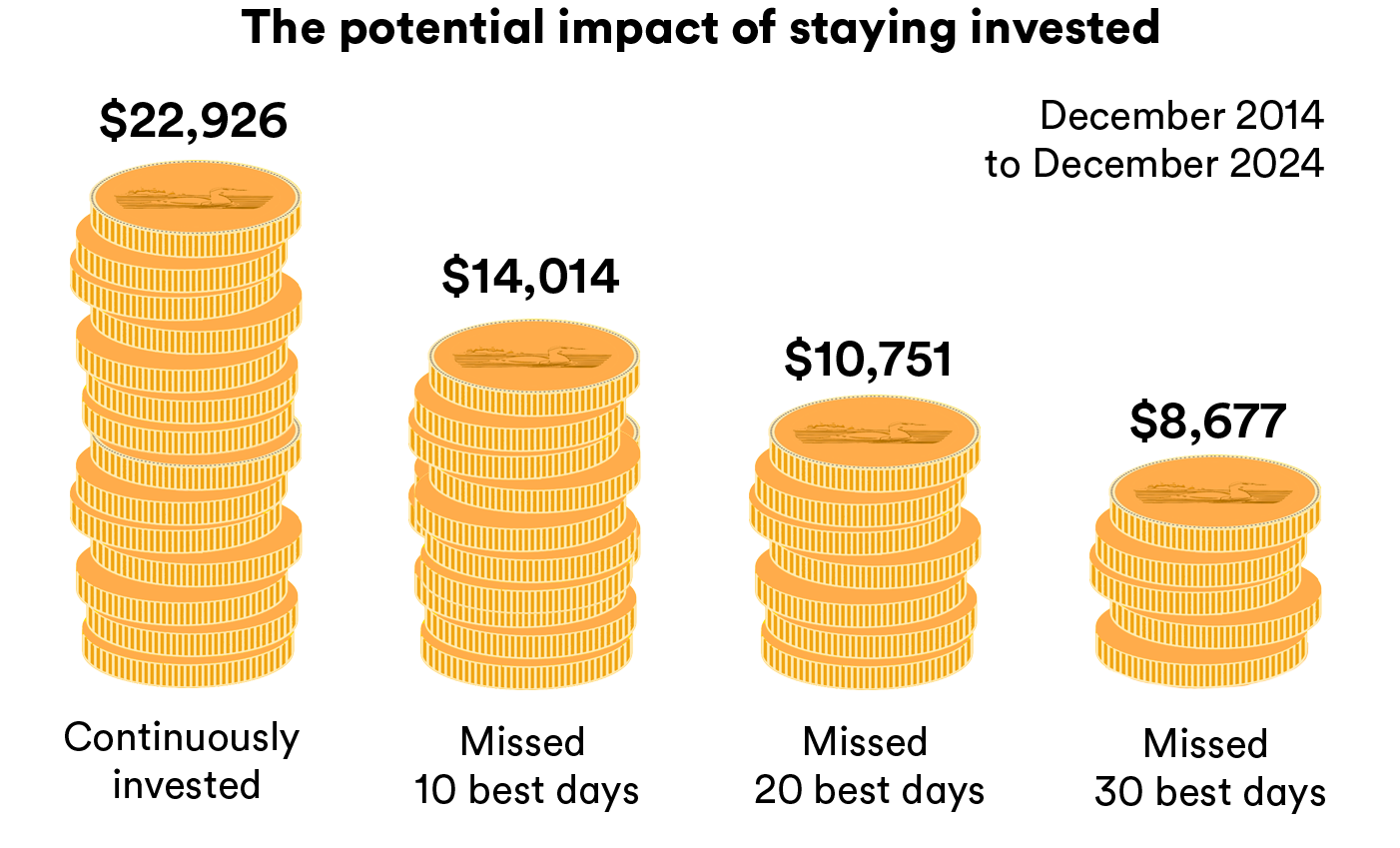
The impact of missing the best 10, 20 and 30 days on the value of $10,000 invested over 10 years vs. staying invested. Source: Morningstar. For illustrative purposes only. S&P/TSX Composite Total Return Index, December 31, 2014, to December 31, 2024. It is not possible to invest directly in an index. Assumes reinvestment of all income and no transaction costs or taxes. Value of investment calculated using compounded daily returns. Missing 10, 20, and 30 best days, excludes the top respective return days.
7. Relying on habit alone
Don’t count on yourself to remember to make contributions to your investments. “Automate your saving and investing life” as much as you can, advises Allen.
That can mean setting up regular automatic contributions to your RRSP or TFSA. It can also mean setting up your accounts to automatically pay credit card or mortgage bills, so you don’t inadvertently fall behind.
Finally, it’s worth turning on alerts for upcoming payments to ensure you have enough money ready in your account.
8. Contributing too little
With Tangerine, you can start investing with as little as $25.
“That’s great if you want to take Tangerine Investments for a test drive, but how much can you afford to put away every month? There is such a thing as contributing too little in my opinion.
“What’s your uncomfortable savings rate? Is it 5% a month? 10%? 15%? Find that point of discomfort and then ratchet it down as needed,” Allen advises.
Investing shouldn’t be painful, but to really grow your worth over time, you should consider contributing to the point where you “feel the pinch.”
9. Paying too much
With a full-service broker, you get a full suite of investment advice, but it may cost you anywhere from 1.5% to 2.5% on the total value of your account annually. It’s a cost that can really add up.
“Not everyone would make full use of the full-service, high-fee model,” Allen says. Many investors can benefit instead from the “light advice” model that Tangerine uses, where in-app tools can give you a broad picture of your performance and net worth, “and a licensed advisor is available whenever you need one.”
10. Not having a clear goal or plan
“People like me are always talking about your goals – stay on track with your goals! – but it’s kind of an abstract word. What does it mean?” Allen asks.
If you remember what you’re really saving for, it is easier to keep those goals in mind.
“’I want to make sure my kids can afford a home one day’ or ‘I want to make sure I won’t run out of money when I stop working’ are really vivid goals and much easier to keep top of mind when you’re looking at the big picture.”
Your financial roadmap should include your defined objectives, time horizon and risk tolerance.
Note that whenever you open a new investment account – at Tangerine or another Canadian financial institution – you will be asked a series of questions that can help to determine these factors, and move your financial goals from abstract to reality.
11. Misunderstanding risk
If you’re expecting to cash out your investments in the next few years, it may not a good idea to put it all in higher-risk funds that contain mostly equities, lest the market slides just when you need the money. In such cases it can be better to put it in something safer, like a GIC, money market fund or high-quality bonds.
But the opposite may be true if you’re working with a longer time horizon.
“I’ve seen people in their 20s and 30s with little more than a savings account or T-bills in their RRSPs,” Allen says. “For them, retirement is still decades away – yet they are barely keeping up with inflation, if that.”
The longer your money stays invested, the more market volatility tends to smooth out over time. Consider tilting your retirement portfolio more heavily into riskier assets such as an equity-focused investment fund while you still have 20 years or more to go, then gradually lowering the risk as the time horizon gets shorter.
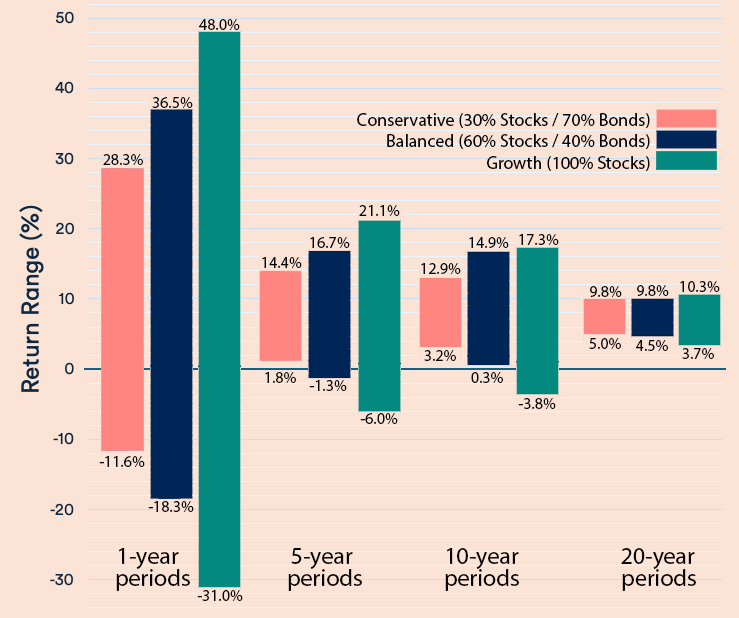
Data: Rolling 1-, 5-, 10- and 20-year periods on the FTSE Canada Universe Bond Index (for the bond part of the portfolios) and the MSCI World GR Index (for the stock component), from Jan. 1, 1986 to Oct. 30, 2025. Source: 1832 Asset Management L.P.
12. Not getting a second opinion
Allen’s final word of wisdom? Take it with a grain of salt.
“Be careful of the experts you listen to in the investing space – this includes media personalities as well as influencers,” Allen says.
“Ninety percent of these people are failing to beat the market indexes.”
Investing is as complicated as you want to make it.
“Our recommendation is to keep it really simple. Buy passively managed index funds aligned to your goals, risk tolerance and time horizon. And keep your fees low. It’s time tested and it’s worked.”
1 Diversification does not guarantee a profit or eliminate the risk of loss.

Ready to start investing?
We’ve got simple options that keep your money working for you in the short and long term.
2 Source. Assumes reinvestment of all dividends.
3 Deposits to TFSA and RSP Accounts are subject to the limits imposed by the Canada Revenue Agency (CRA). You are fully responsible for monitoring your individual contribution limits and ensuring any and all deposits fall within these set CRA limits.