



















Five strategies for moderate-risk investors to consider
Investing doesn't need to be a choice between going all-in or playing it ultra-safe. Many people want their money to grow, but also want some stability when markets get rough. That's a balanced investor: someone willing to take on a moderate risk to potentially capture growth while keeping a buffer against downturns. They're not trying to win the lottery with their investments, but they're not content to watch their savings lose ground to inflation, either.
Let's look at what it means to be a balanced investor, who this approach might be best suited for, and five practical strategies to help you put moderate-risk investing into practice.
👉Did you know? All mutual fund dealers, including Tangerine Investments, are required by regulators to create an investor profile that includes your financial situation, investment objectives, time horizon, risk tolerance and knowledge of investing. By answering a series of questions, both you and the dealer can determine an investing plan best suited to your situation.
What is moderate risk investing?
Moderate risk investing is about finding the middle ground between high-risk, high-reward investments and low-risk, low-reward ones. Balanced investors want their portfolios to grow over time, but they're not comfortable with the full volatility of an all-stock portfolio. Instead, they combine equities for potential growth with fixed income for stability.
A conservative investor would tilt more heavily toward fixed income, including bonds, GICs or cash equivalents. They focus on protecting wealth and generating steady income, even if it means lower returns.
An aggressive investor is at the other end of the spectrum, often investing almost entirely in stocks to maximize potential growth. This can potentially produce strong long-term results but may come with significant short-term volatility.
Balanced investors sit in between. They accept some risk in exchange for potential growth but still want a measure of stability.
Pop Quiz: Which is considered the classic moderate-risk portfolio?

50% bonds, 50% stocks
Good guess, but not quite.
Try again.
60% stocks, 30% bonds, 10% lottery tickets
You knew this one was wrong. You just wanted to see what the other side of the card said, right?
60% stocks, 40% bonds
Bingo!
Way to find balance.
This moderate approach can be suitable for a wide range of investors, such as mid-career professionals who want to balance potential growth and safety, or young families who need stability for unexpected expenses but also need growth to help meet long-term goals like saving for a home or a child's education. Pre-retirees also often fall into this category. They invest their money with the aim that it will continue to grow, but can't afford to see their retirement savings drop just as they prepare to leave the workforce.
1. Consider a 60/40 portfolio
The classic example of moderate risk investing is the 60/40 portfolio, with 60 percent allocated to equities and 40 percent to bonds. This mix has been around for decades and for good reason. The equities provide growth potential, while the bonds act as ballast when stock markets decline.
The 60/40 portfolio reflects what Nobel Prize winner Harry Markowitz called Modern Portfolio Theory—the idea that diversifying across asset classes aims to actually improve returns while reducing risk.
Consider an investor who put $100,000 into a 60/40 portfolio 20 years ago. They would have seen their money grow substantially, but with fewer sharp drops than if they had gone all-in on equities. The all-equity investor might have earned a higher return in the end, but they would have had to stomach several declines of more than 20% percent along the way. Many investors simply would not stay invested through that kind of volatility. The 60/40 mix gives you a smoother ride.
That does not mean 60/40 is right for everyone. A younger investor with decades until retirement and an appetite for more risk may tilt their mix toward growth, perhaps 70/30. Someone closer to retirement with less tolerance for risk may prefer 50/50 to reduce volatility further. The key is finding the allocation that fits your comfort level and time horizon.
The benefits of the 60/40 model are its long history of strong risk-adjusted returns and its simplicity. The drawbacks are that it may feel too risky for very cautious investors, with declines as steep as -30 percent during the Great Financial Crisis. A 60/40 portfolio may lag behind all-equity portfolios when stocks are booming, and bonds themselves can struggle during periods of rising interest rates. Still, the 60/40 portfolio has stood the test of time as a benchmark for balanced investing.
2. Diversify across sectors and geographies
Balanced investing is not just about mixing stocks and bonds. It's also about ensuring your investments are not overly concentrated in one sector or country. Canadian investors often exhibit what's called home bias, meaning they hold a large percentage of their investments in Canadian stocks. The Canadian market is heavily tilted toward financials, energy and telecommunications. While these are important industries, they represent only a small fraction of the global economy.
Diversification across geographies and sectors reduces the risk that one industry or one region will drag down your entire portfolio. For example, when U.S. technology stocks collapsed in 2000, Canadian resource companies performed well. When oil prices plunged in 2014-15, U.S. and international stocks helped offset losses in Canadian energy. During the COVID-19 recovery, technology and healthcare surged while other sectors lagged.
A well-diversified, balanced portfolio might include Canadian equities for home-country stability, U.S. equities for exposure to global leaders, international equities for Europe and Asia, and bonds from both Canadian and international issuers. This broader diversification helps ensure your portfolio has different sources of return over time. Just as you wouldn't eat only one food group and expect to stay healthy, your portfolio needs variety to stay resilient.
👉 Tangerine Portfolios are globally diversified.
3. Take advantage of tax-efficient asset location
Where you hold your investments can be as important as what you invest in. Balanced investors could improve after-tax returns by placing the right types of investments in the right accounts.
Bonds and other interest-earning investments are best held in a Registered Retirement Savings Plan (RRSP, or RSP at Tangerine) or Tax Free Savings Account (TFSA). Interest income is fully taxable in a non-registered account, but it is tax-deferred until withdrawal in an RRSP, and completely tax-free in a TFSA. Equities and growth-oriented investments are a natural fit for a TFSA, where all gains and withdrawals are tax-free. If you max out your RRSP and TFSA, non-registered accounts can be used strategically. Canadian dividend-paying stocks benefit from a dividend tax credit, and capital gains are taxed more favourably than interest income.
Imagine a balanced investor with $200,000 split 60/40. If the $80,000 in bonds is held in a taxable account, the interest could generate thousands of dollars in taxable income each year. By holding the bonds in an RRSP and the equities in a TFSA, the investor could improve their after-tax returns without changing the underlying risk profile. This is the essence of tax efficiency: getting more from your portfolio by working smarter.

Get up to a 3% bonus on your investments
Earn more for your investment journey. Start with 2% when you invest, then refer a friend to reach 3%.*
4. Stay invested and rebalance periodically
Even a carefully constructed balanced portfolio will drift over time. If stocks have a strong year, your 60/40 portfolio could become 70/30. If bonds rally, you might find yourself tilted more defensively. This is where rebalancing comes in.
Rebalancing means selling a portion of what has grown beyond its target weight and buying more of what has lagged. For example, if your 60/40 portfolio drifts to 70/30, you would sell some equities and buy more bonds to restore the balance. This process forces you to buy low and sell high, which is the opposite of what many investors do when they act on emotion.
How often should you rebalance? Regularly, which is why asset allocation funds like Tangerine's Investment Funds rebalance frequently to maintain their target asset mix and prevent the portfolio from drifting too far in the direction of equities or bonds.
Equally important is the principle of staying invested. Jumping in and out of the market based on short-term news usually does more harm than good. During the financial crisis of 2008, many investors sold in panic and missed the strong rebound that followed. Balanced investors who stayed the course saw their portfolios recover and grow.
👉 Tangerine Portfolios are reviewed and rebalanced as needed every quarter.
The effect of time on investing strategies
The graph below shows the range of possible outcomes for three risk profiles invested over different time periods between Jan. 1, 1986 and Oct. 30, 2025. The outcomes show that the longer you stay invested, the less volatility is apparent.
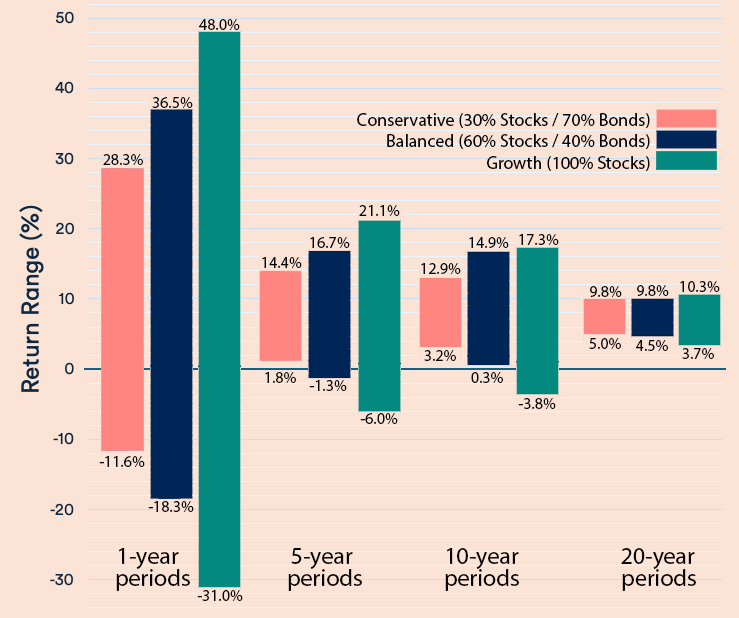
Data: Rolling 1-, 5-, 10- and 20-year periods on the FTSE Canada Universe Bond Index (for the bond part of the portfolios) and the MSCI World GR Index (for the stock component), from Jan. 1, 1986 to Oct. 30, 2025. Source: 1832 Asset Management L.P.
5. Align your portfolio with your goals
Balanced investing is not one-size-fits-all. A 60/40 portfolio is a good starting point, but your exact allocation should reflect your personal goals and timeline.
If you plan to buy a home in the next three to five years, you may want to keep some of your investments in safer, more predictable assets like a savings account, GICs or bonds.
If you're investing for retirement, a balanced portfolio aims to give you steady growth while also protecting against significant declines as you get closer to leaving the workforce.
The important point is that balanced investing should support your goals, not just follow a formula. Two people with the same risk tolerance might have different portfolios if one is saving for retirement in 30 years and the other is planning a major purchase in five years.
Balanced investing is a strategy, not a compromise
Balanced investing is sometimes misunderstood as settling for the middle. In reality, it is a deliberate strategy that combines growth and stability in a way that can help you reach your goals. A moderate-risk portfolio exposes you to the long-term growth of global markets while also providing protection when volatility rises.
This approach works well for many Canadians, especially those who are mid-career, raising families, or approaching retirement. By diversifying across asset classes, using tax-efficient accounts, rebalancing regularly, and aligning your investments with your goals, you can aim to build wealth steadily and confidently.