




















How do mutual fund distributions work?
Mutual funds are a popular way for Canadians to invest because they offer plenty of benefits—like diversification, professional management, affordability and convenience.
But how do they make you money? That’s what we’re here to discuss: the often misunderstood mutual fund trust* income known as distributions.
What are mutual fund distributions?
Simply put, a mutual fund distribution represents some or all of the money your fund earns from its investments. If the fund kept all those earnings, it would be taxed at the highest marginal rate, so instead, it passes some of the money to you as a distribution. That way, you’re taxed at your own—typically lower—rate, which can help boost the fund’s overall returns.
Do I have to pay taxes on mutual fund distributions?
Distributions are subject to taxation, unless they are received in a registered account, such as an RRSP or TFSA.
What’s in a mutual fund distribution?
Funds can generate taxable distributions in two main ways:
- by earning income from the fund’s underlying investments—think interest from bonds or dividends from stocks.
- When the fund sells investments for a profit, you get a share of the capital gains. If it sells at a loss, that's a capital loss. Any net capital gains (that is, gains minus losses) have to be paid out to investors by the end of the calendar year.
👉Did you know? Most investors have to report these distributions as part of their taxable income for the year—even if they don’t actually get the money in cash and it’s just reinvested back into more fund units. The only exception is when the distributions are paid into a registered account like an RRSP or TFSA. How much tax you’ll owe depends on what kind of income makes up that distribution.
Questions to ask about mutual fund distributions
The way distributions are treated can differ from fund to fund, so it’s helpful to know how your own fund distributions work. Check the Fund Facts document to get a better understanding.
Are my distributions fixed?
Some funds offer distributions that may vary from year to year, while others offer set distribution amounts (usually monthly or quarterly). These fixed distributions are not guaranteed and may be subject to change at the discretion of the fund manager. If a fund earns net income and net capital gains exceeding the total fixed distribution amount for the year, the fund will be required to distribute the excess by the end of the calendar year, usually in late December. On the other hand, if a fund paid total fixed distribution in excess of the fund’s net income and net capital gains for the year, the excess distribution is treated as a return of capital (ROC).
How often are distributions made?
The frequency of a distribution varies by fund and can be paid monthly, quarterly, or annually. These distribution frequencies are usually stipulated in the distribution policy within the fund’s offering document.
👉Distributions from Tangerine Portfolios are paid out annually in December, with the exception of the Money Market Fund, which makes monthly distributions.
How are they paid?
While distributions can be paid in cash, they are more commonly reinvested in additional units of the fund. At Tangerine, distributions on funds held within a registered account are automatically reinvested. If the funds are held in an non-registered account, they will also be automatically reinvested unless you instruct otherwise.
Are distributions the same as fund performance?
The two are connected but they are not the same thing. The total return on your investment in the fund comes from two sources: 1. The distributions, and 2. The overall growth in the fund’s market value. So, distributions are only one component of the fund performance.
What dates do I need to know?
Record Date: The date on which the fund determines the eligible units that will receive the distribution from the fund. In other words, if you own the fund as of this date, you will be entitled to receive the distribution.
Distribution Date: The date on which a mutual fund pays out the distribution amount to investors as cash or reinvests them in additional units of the fund.
What is Net Asset Value?
Consider this the mutual fund equivalent of a stock’s price. Net Asset Value (NAV) per unit represents the mutual fund’s assets minus its liabilities divided by the number of units outstanding. It changes over time due to fluctuations of the market value of the mutual fund’s investments. A fund’s NAV is generally calculated daily using the price of the securities in the mutual fund at the market close.
How much tax do I have to pay on distributions?
Remember, you do not have to pay tax on distributions made within a registered account like a TFSA or an RRSP. For funds held in non-registered accounts, here’s what you need to know about how distributions are taxed.
Type of Distribution |
Description |
Tax treatment |
|---|---|---|
Interest and other income |
Interest income earned by the fund from fixed income securities such as bonds. Also includes income from certain derivatives. | Fully taxed at your marginal tax rate. |
Foreign source income |
Income earned from non-Canadian sources, such as dividends or interest from foreign investments. | Fully taxed at your marginal tax rate. Investors may be entitled to tax credits in relation to foreign withholding taxes. |
Canadian dividends |
Dividends represent a distribution of a company’s earnings to shareholders. A fund receives dividend income when it invests in shares of publicly traded Canadian companies that pay dividends.
|
The dividend income Canadian corporations is taxed at a preferential rate.
|
Capital gains |
Capital gain is generated when a fund’s investment is sold for more than it was purchased for. |
Currently, 50% of realized capital gains are taxed at the investor’s marginal tax rate. |
Return of capital (ROC) |
Some mutual funds (unlike Tangerine’s) offer a fixed distribution amount to be paid out of the fund on a periodic basis, such as monthly or quarterly. When this fixed distribution amount exceeds the total net income and net capital gains of the fund, the excess component of the distribution is considered a return of capital (ROC). For tax purposes, a ROC distribution represents a return of a portion of your own invested capital.
|
Generally, it is not taxable when received. ROC reduces the cost base of the investor’s investment in the fund, resulting in an increase in capital gain or decrease in capital loss when the investor disposes of the investment.
|
How do distributions affect the Net Asset Value?
When a distribution is made, the fund’s price will go down because the fund now holds fewer assets as a result. The reduction in NAV is equivalent to the amount of the distribution (without accounting for any market fluctuation).
Don’t worry – it all evens out. Consider the following example. If an investor held 100 units of a mutual fund with a NAV of $10, and the distribution was $0.30/unit, the $30 payout would be reinvested into additional units of the fund at the now lower NAV ($9.70), allowing for the purchase of a greater number of units than before the distribution.
Or, if the investor opts to receive the distribution of cash, they would receive a taxable distribution of $30 – which balances out the $970 they have remaining in the fund.
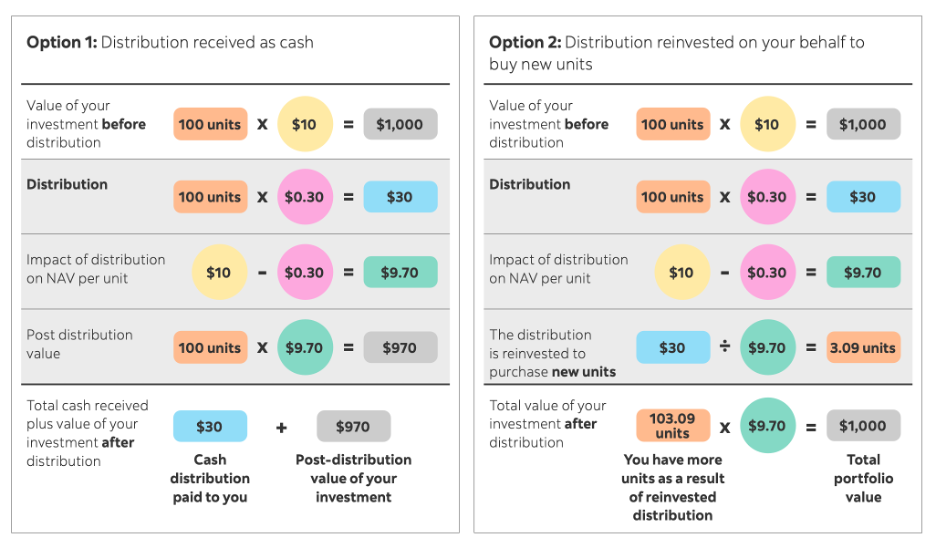
Assumptions: To illustrate the impact of the distribution, we have assumed that there are no market fluctuations.
When is the best time to purchase a mutual fund?
Purchasing a mutual fund in a non-registered account before it pays an annual distribution could trigger an
unwelcome tax bill. While the exact timing of year-end distributions depends on the fund company, most
occur in December. Consider speaking to a Tangerine Advisor about the best approach for you.
(Note: if you intend to hold the fund in a registered, tax-advantaged account such as an RRSP, the timing may not make as much of a difference.)
How do distributions affect the adjusted cost base?
The adjusted cost base (ACB) of a non-registered mutual fund can be important when tallying up your tax return. The ACB is the total cost paid for all of the mutual fund units owned plus or minus certain. The ACB is compared with the sale price to determine if a capital gain or capital loss is realized when you sell the mutual fund units.
Distributions paid in cash and distributions that are reinvested in additional units of the fund have different impacts on the ACB.
Distribution option |
Impact on Fund value |
Impact on ACB |
|---|---|---|
Cash distribution |
Unit price decreases by the amount of the distribution and the total fund value decreases. |
No impact on ACB unless the distribution consists of ROC, which will reduce the ACB by the ROC amount. |
Reinvested distribution |
Unit price decreases by the amount of the distribution; however, since the distribution is reinvested, the total fund value does not change. |
The total ACB increases by the reinvestment distribution amount less any ROC component of such distribution. |
The bottom line
Understanding distributions, their benefits and tax implications are especially important to any investor holding mutual funds in a non-registered account. Be sure to seek professional investment and tax advice to better understand your own circumstances and goals.

Get up to a 3% bonus on your investments
Earn more for your investment journey. Start with 2% when you invest, then refer a friend to reach 3%.*
1 Diversification does not guarantee a profit or eliminate the risk of loss.
*Note that this article only covers mutual fund trusts. These are the better-known type of mutual funds, and include the ones offered by Tangerine Investments. Different rules apply to corporate class mutual funds.
**Mutual fund trusts are entitled to certain tax credits that may be available to reduce income and capital gains distributions.